Best R-38 Rigid Insulation Options for Attics and Walls
Choosing the right insulation matter for delivering steady temperatures, reducing energy bills, and boosting home comfort. This guide highlights top insulation products that align with R-38 performance and rigid insulation goals, plus related accessories that support efficient installation and long-term durability. Below you’ll find quick-start product insights, a comparison snapshot, and practical buying considerations to help American homeowners and contractors make informed decisions.
| Product | Brand | Type | R-Value / Notes |
|---|---|---|---|
| Owens Corning R-38 Kraft Faced Fiberglass Batt | Owens Corning | Kraft Faced Fiberglass Batt | R-38 (Batt, 2×12 attic use) |
| Owens Corning R-38 Unfaced Fiberglass Batt | Owens Corning | Unfaced Fiberglass Batt | R-38 (Batt, interior applications) |
| SmartSHIELD -5mm 16”X50ft Reflective Insulation Roll | INSULATION MARKETPLACE | Reflective Radiant Barrier Roll | R-17 equivalent through radiant reflection |
| US Energy Products R-8 Duct Wrap Insulation | Trade Winds | Double-Sided Reflective Foam Core | R-8 (Class 1-A Fire Rated) |
| Additional R-38 Option (Representative) | Various | Rigid Insulation Context | R-38 context in rigid forms |
Insulation Product 1: Owens Corning R-38 Kraft Faced Fiberglass Batt

These Kraft faced fiberglass batts deliver a convenient option for 2×12 attic applications and similar wall assemblies. The Kraft facing provides a moisture barrier and helps with installation alignment. The insulation is designed to help maintain interior temperatures while contributing to sound dampening. The product is described as suitable for exterior walls and interior walls, ceilings, and attics when installed with appropriate ventilation and clearances. The Kraft facing supports moisture control in typical residential builds, and the batts are engineered for easy handling during installation.
Insulation Product 2: Owens Corning R-38 Unfaced Fiberglass Batt
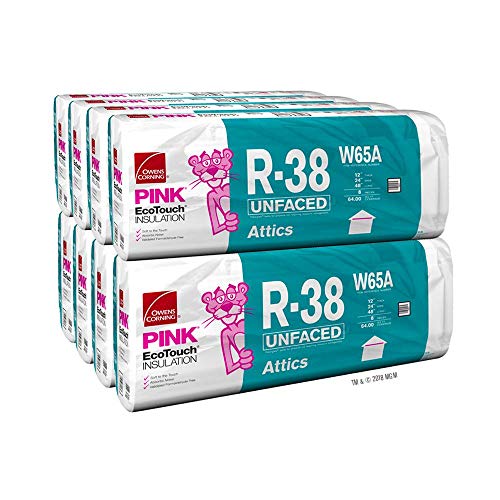
This unfaced fiberglass batt option targets attic and interior wall installations where a separate vapor barrier is provided or not required by local code. The product emphasizes formaldehyde-free composition and a soft touch for easier handling. It is framed as suitable for maintaining temperatures and providing some degree of acoustic control. Since it lacks facing, it relies on the building envelope and ventilation strategy to manage moisture and dew point concerns in various climates.
Insulation Product 3: SmartSHIELD -5mm Reflective Insulation Roll

The SmartSHIELD reflective insulation roll features a foam core and a radiant barrier designed to reflect up to a large portion of radiant energy. This can complement existing insulation by reducing heat transfer through radiant heat, particularly in attics and roof assemblies. It serves as an additional layer rather than a primary insulation system. The product notes include a Class A fire rating and moisture resistance properties to support durable performance in humid environments.
Insulation Product 4: US Energy Products R-8 HVAC Duct Wrap Insulation

This double-sided reflective duct wrap insulation is designed for HVAC ductwork, offering a robust foam core and moisture resistance. While rated R-8, it is commonly used as a supplementary or localized insulation solution around ductwork, improving overall system efficiency. The product emphasizes durability with heavy-duty scrim and a corrosion-resistant surface, and meets Class 1 / Class A fire standards, which can be an important consideration for safe installation in various building codes.
Insulation Product 5: Additional R-38 Contextual Option
In many projects, builders combine rigid insulation boards or batts to achieve a total R-38 value in attic or wall assemblies. When selecting an additional R-38 context, consider compatible materials, vapor barriers, installation methods, and local climate guidelines. This section highlights how R-38 can be realized through multiple material strategies, from high-density batt insulation to rigid foam boards, while ensuring proper ventilation and moisture management are maintained across the structure.
Buying Guide: Key Purchase Considerations for R-38 Rigid Insulation
Bottom-line guidance focuses on performance, compatibility, and long-term durability. Here are essential considerations when evaluating rigid insulation options for achieving R-38 efficiency:
- R-value and thickness: Confirm the specific R-value per inch for rigid boards, and calculate total thickness to meet a target R-38 in your climate and code requirements.
- Material type: Rigid foam boards (polyiso, XPS, or EPS) offer high R per inch and moisture resistance. Fiberglass batts can achieve R-38 but are not rigid; ensure proper installation and support for long-term performance.
- Air and vapor barriers: Determine whether you need additional vapor barriers or air sealing steps. Proper sealing reduces thermal bridging and moisture-driven problems.
- Fire safety: Look for product ratings such as Class A fire rating, and verify compatibility with local building codes and attic or wall assembly requirements.
- Moisture resistance: In moist or humid climates, select materials with moisture resistance and consider face coverings, facings, or moisture-retardant backings that suit your application.
- Installation considerations: Rigid insulation boards require careful cutting, fitting, and fastening. Check for compatibility with studs, joists, trusses, and existing insulation layers.
- Environmental impact: Evaluate recycled content, off-gassing, and formaldehyde-free formulations when available, especially for indoor air quality concerns.
- Cost and availability: Compare total installed costs, ease of procurement, and compatibility with existing HVAC and ventilation plans to optimize value over the life of the home.
This guide presents a balanced view of rigid and related insulation options tied to an R-38 framework, emphasizing objective performance data and installation practicality. For code compliance and precise installation details, consult local building codes and a licensed insulation professional.