Best Cable Railing: Choosing Vertical or Horizontal Posts and Kits for Your Space
When planning a cable railing project, deciding between vertical and horizontal posts often drives layout, safety, and aesthetics. This guide compares popular options—from horizontal post systems to complete hardware kits—so readers can make an informed choice for indoor or outdoor spaces. You’ll find product highlights, installation notes, and purchase considerations to weigh durability, corrosion resistance, and ease of use across different environments.
| Product | Brand |
|---|---|
| VEVOR 4 Pack Cable Railing Post | VEVOR |
| Steel DN Mate Swage Lag Screws Kit | Steel DN Mate |
| Muzata 50 Pairs CK07 Kit | Muzata |
| BLIKA 10 Pair Kit | BLIKA |
| Muzata 10 Pairs CK07 Kit | Muzata |
VEVOR Horizontal Railing Post (36″ / 42″)

VEVOR’s horizontal railing post is designed for deck and balcony applications with horizontal wire runs. Available in 36″ and 42″ heights, it features 0.31″ and 0.41″ hole sizes for a tidy, even grid. The design accommodates multiple holes (about 10–12 per post) and is crafted from SUS304 stainless steel for rust resistance and durability. Note: it does not include wire ropes and is not ideal for coastal environments. The horizontal hole spacing is set at 3″ with typical post spacing under 4 feet to meet common safety tests.
Steel DN Mate Swage Lag Screws Kit
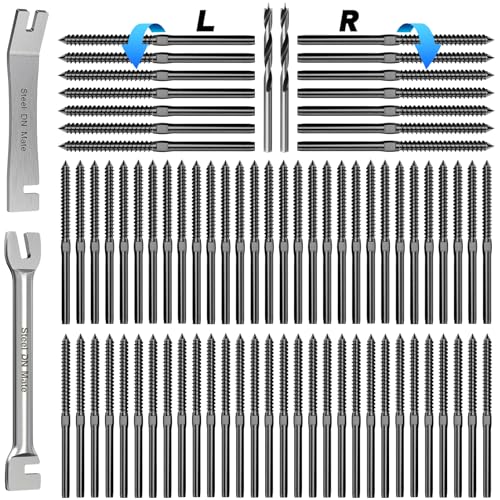
This kit in black combines a clean, modern look with corrosion resistance thanks to stainless steel 316 components. It’s designed for 1/8″ black cable rails and is suitable for both vertical and horizontal configurations. The included wrench simplifies installation and helps manage cable tension. The hardware supports wood posts and is intended to reduce twisting or damage to the wire. For best results, maintain post spacing within 16 feet and keep intermediate spacing under 4 feet with 4″ cable spacing tolerance.
Muzata CK07 50-Pair Cable Railing Kit

The Muzata CK07 kit focuses on multi-angled adjustments and ease of installation. It includes 50 turnbuckles, 50 terminals, 200 screws, and a bent wrench, along with enough hardware to support up to 30 feet of cable runs across multiple sections. Turnbuckle rotation spans 0–180 degrees, enabling precise tensioning for stair and deck applications. Installation is straightforward—no pre-drilling required—making it suitable for DIY projects on wood posts and sleeve-supported posts. Adhere to a maximum 4-foot post spacing and 4-inch cable spacing for safety.
BLIKA 10 Pair Black Cable Railing Kit

BLIKA’s black 1/8″ cable railing kit provides stylish, rust-resistant hardware for both indoor and outdoor applications. Made from 316 stainless steel with a black finish, the kit is suitable for wood posts and can be used on stairs or horizontal sections. The included turnbuckles and toggles offer 180° angle flexibility. Sizes are designed to fit typical 2″x2″ or 4″x4″ posts, with guidance suggesting appropriate cable length adjustments to achieve desired tension and stability in various layouts.
Muzata CK07 10-Pair Kit

The Muzata CK07 10-pair kit mirrors the CK07’s flexibility with a reduced count, making it ideal for smaller projects or precise segment replacements. It supports 1/8″ wire rope for stair and horizontal layouts, offering 0–180° turnbuckle rotation and a max length around 10.1 inches. The kit includes 10 turnbuckles, 10 terminals, 42 screws, and a bent wrench. For consistent results, limit end-post distance to 4 feet and maintain 4-inch spacing between cables, ensuring steady tension and long-lasting performance.
Introduction to Horizontal Versus Vertical Railing Systems
Horizontal railing posts favor a contemporary look with a linear cable pattern that runs parallel to the deck or balcony floor. They typically require precise post spacing and 3″ hole increments to meet safety standards. Horizontal systems perform well for clean sightlines, ease of tensioning, and straightforward maintenance. Vertical posts, by contrast, emphasize traditional railing aesthetics and can integrate vertical wire runs or pickets. They can be more forgiving for uneven terrain or curved layouts but may demand different hardware arrangements to ensure uniform tension and stability.
Key Material And Durability Considerations
Stainless steel is standard for most railing hardware due to corrosion resistance, especially in outdoor and coastal environments. Look for 316 stainless steel when coastal exposure is a factor, and ensure the chosen kit includes corrosion-resistant components that suit your climate. For black finishes, confirm a durable coating that resists chipping and tarnish. Post material matters as well; SUS304 is common for posts, but consider the environment to decide whether 316-grade components are warranted for longevity.
Installation And Safety Considerations
Post spacing typically should not exceed 4 feet between end posts to satisfy common safety tests, while cable spacing generally stays under 4 inches for structural integrity. Turnbuckles should rotate smoothly through a wide angle (0–180 degrees) to accommodate stair angles and bends. Pre-drilling is not always required, but precise measurement and alignment are essential to achieve uniform tension and to prevent cable skewing or post misalignment.
Comparative Pros And Cons
- Horizontal posts: Sleek lines, easier tensioning, best for straight runs; can require careful post spacing planning.
- Vertical posts: Classic appearance, robust for irregular layouts; may need more post integration work for non-straight runs.
- All-metal hardware: Durable in varied climates; stainless steel and black finishes offer different aesthetic options.
- DIY readiness: Many kits are designed for simple tightening and minimal pre-drilling, but installation accuracy remains critical.
Buying Guide: Key Purchase Considerations
-
<liEnvironment: Outdoor vs indoor, coastal exposure, and temperature ranges influence material choice (316 stainless steel recommended for harsh environments).
<liPost Type: Horizontal posts yield modern lines; vertical posts provide traditional looks. Pick based on your space’s architecture and sightlines.
<liCable and Hardware Compatibility: Confirm cable diameter (commonly 1/8"), post hole sizes, and compatible mounting hardware to prevent mismatches.
<liInstallation Ease: Look for kits that include necessary wrenches, terminals, and turnbuckles for a smoother workflow; non-pre drilling options can save time but verify required tools.
<liSafety Standards: Ensure spacing guidelines align with your local codes and common safety tests (e.g., 4" ball test; post spacing under 4 feet).
<liAesthetic Finishes: Choose finishes (e.g., SUS304 black, or 316 stainless) that match railings, balusters, and outdoor décor for a cohesive look.
<liBudget And Availability: Compare kits by the number of pairs, included hardware, and anticipated maintenance to maximize longevity within budget.